Cloud and DevOps: Accelerating Digital Transformation in Modern Enterprises
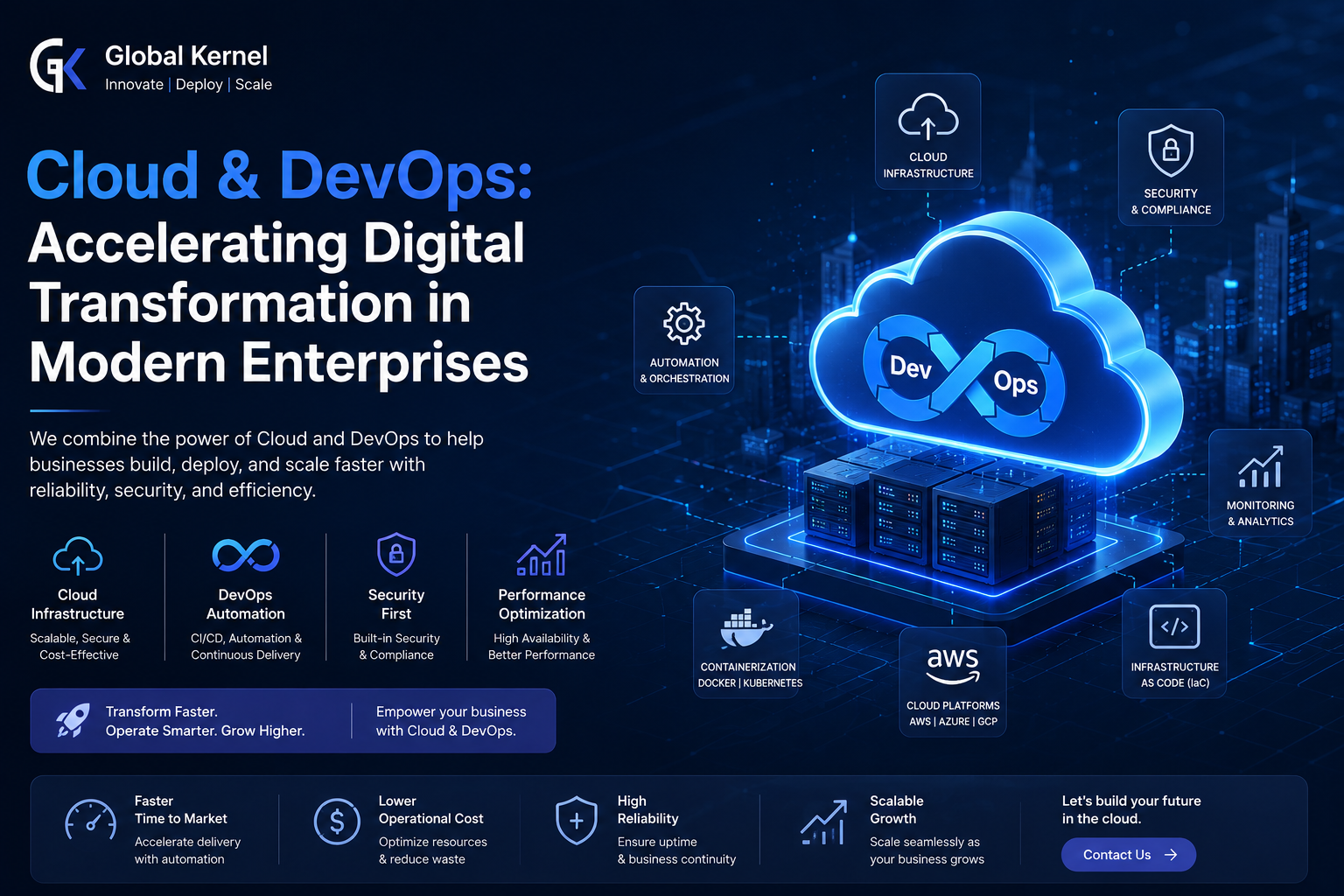
Cloud computing and DevOps practices have become the twin engines of digital transformation in modern enterprises. Together, they enable organizations to deliver software faster, operate more reliably, and respond to market changes with unprecedented agility. This article explores how Cloud and DevOps work together to accelerate digital transformation.
The Cloud Foundation
Cloud computing provides the infrastructure foundation for digital transformation. Whether public, private, or hybrid, cloud platforms offer on-demand access to computing resources, storage, and services that would be costly and time-consuming to provision on-premise. The leading cloud providers AWS, Microsoft Azure, and Google Cloud offer hundreds of services that can be combined to build virtually any application architecture.
The economic benefits of cloud computing are well-documented. Organizations reduce capital expenditure on hardware, pay only for what they use, and can scale resources up or down based on demand. This flexibility is particularly valuable for businesses with variable workloads or rapid growth trajectories.
DevOps: The Cultural and Technical Practice
DevOps is both a cultural movement and a technical practice that emphasizes collaboration between development and operations teams. The goal is to shorten the development lifecycle while delivering features, fixes, and updates frequently and reliably. DevOps practices include continuous integration, continuous delivery (CI/CD), infrastructure as code, monitoring, and observability.
Organizations that adopt DevOps practices deploy code 208 times more frequently than their competitors, according to industry research. They also experience change failure rates that are seven times lower and restore service 2,604 times faster. These metrics demonstrate the transformative impact of DevOps on software delivery performance.
CI/CD Pipelines
Continuous Integration and Continuous Delivery pipelines are the backbone of DevOps automation. A CI/CD pipeline automatically builds, tests, and deploys code changes, ensuring that every change is validated before reaching production. This automation eliminates manual deployment errors, accelerates release cycles, and provides confidence in the deployment process.
Modern CI/CD pipelines integrate security scanning, performance testing, and compliance checks into the deployment workflow. This shift-left approach catches issues early in the development process when they are cheaper and easier to fix. The result is higher quality software delivered faster and more safely.
Infrastructure as Code
Infrastructure as Code (IaC) treats infrastructure provisioning and management as a software engineering practice. Tools like Terraform, AWS CloudFormation, and Pulumi enable teams to define infrastructure in code, version control it, and deploy it through automated pipelines. IaC ensures that environments are consistent, repeatable, and auditable.
The benefits of IaC extend beyond consistency. Teams can create and destroy environments on demand for development, testing, and staging. Disaster recovery becomes a matter of redeploying infrastructure from version-controlled templates. Compliance requirements can be enforced through code rather than manual processes.
Monitoring and Observability
Modern applications require sophisticated monitoring and observability practices. Metrics, logs, and traces provide visibility into application performance, user behavior, and system health. Tools like Prometheus, Grafana, the ELK Stack, and Datadog enable teams to detect and respond to issues before they impact users.
Observability goes beyond traditional monitoring by enabling teams to understand not just what is happening, but why. Distributed tracing follows requests across microservices, identifying bottlenecks and failure points. Structured logging provides searchable, analyzable records of system behavior.
Conclusion
Cloud computing and DevOps practices are essential for organizations pursuing digital transformation. Together, they enable faster delivery, higher reliability, and greater operational efficiency. Organizations that invest in Cloud and DevOps capabilities position themselves to compete effectively in an increasingly digital marketplace.
Ready to Accelerate Your Cloud & DevOps Journey?
Global Kernel provides comprehensive Cloud and DevOps services. From migration to managed services, we help organizations transform their technology operations.
Request a Quote →